
Why Hexagonal Puzzle Pieces Create a Richer Solving Experience
Updated: Apr 8
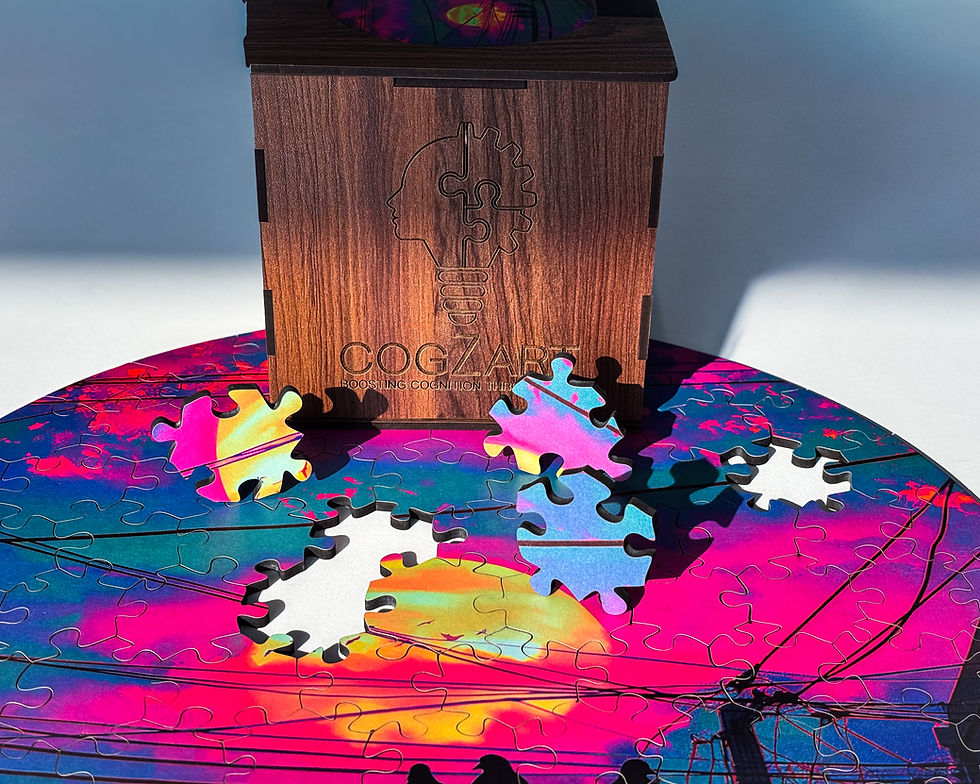
Some puzzles feel familiar from the very first minute, yet puzzles built with hexagonal puzzle pieces introduce a refreshing rhythm and visual curiosity. A circular puzzle guides the eyes along smooth curves, allowing the artwork to unfold from multiple directions instead of following rigid borders. Each section encourages patience, observation, and spatial awareness.
Why hexagonal puzzle pieces change the experience
The solving journey begins with the geometry of the pieces themselves. Hexagonal puzzle pieces connect in six directions, opening more possibilities for sorting, comparing, and aligning. This unique structure creates a dynamic solving flow where each move invites careful observation.
Nature often relies on hexagonal forms, such as honeycomb structures, because they organise space efficiently. Within a puzzle, the same geometry brings harmony and visual rhythm to the solving process. Each successful connection feels satisfying, encouraging puzzlers to continue exploring the image as it gradually unfolds.
A circular layout invites fresh thinking
A circular puzzle changes the way people interact with the puzzle board. Instead of following straight edges, the eyes travel across curved paths that guide attention around the artwork.
This circular movement encourages a different solving mindset:
• Color patterns appear in flowing sequences rather than rigid borders
• Symmetry becomes a helpful clue across multiple directions
• Small visual elements echo throughout the design
• The mind compares shapes and colors continuously during assembly
Research on jigsaw puzzles and spatial reasoning highlights connections with pattern analysis, mental rotation, and visuospatial awareness. These cognitive processes make puzzle solving feel engaging and mentally stimulating. The circular layout strengthens this experience by allowing ideas and visual cues to emerge naturally during the solving journey.
Art, theme, and display value in one puzzle
CircZle puzzles also stand out through their thematic artwork. Each collection introduces a unique visual world that invites curiosity.
Sacred Geometry explores balance and symmetry through intricate patterns. Introspective reflects calm and thoughtful visuals. Antariksh brings cosmic exploration into puzzle form, while Imaginarium offers surreal creativity. Carbon-Based Life draws inspiration from biological forms and natural systems.
These themes transform puzzle-solving into a visual journey. Once completed, the circular artwork carries an elegant presence that fits beautifully on shelves, desks, or framed displays.

Smart materials that elevate every session
Material design plays an important role in the overall puzzle experience. Circular Puzzles describes CircZle puzzles as created using upcycled sawdust, precise laser cutting, and vaporised ink technology that produces vibrant, detailed imagery.
This approach allows the puzzle pieces to feel smooth, durable, and visually crisp. The puzzles come in sizes ranging from 8 to 16 inches and feature multiple difficulty levels, giving puzzlers the flexibility to enjoy quick sessions or deeper immersive challenges. During the process, hexagonal puzzle pieces support constant visual comparison, helping the puzzle gradually reveal its full design.
Citations:
Frontiers in Ageing Neuroscience – Jigsaw Puzzling Taps Multiple Cognitive Abilities and Is a Potential Protective Factor for Cognitive Aging https://www.frontiersin.org/articles/10.3389/fnagi.2018.00299/full
Frontiers in Education – Spatial Reasoning in Context: Bridging Cognitive and Educational Perspectives https://www.frontiersin.org/articles/10.3389/feduc.2023.1302099/full
Scientific Reports (Nature) – The Hexagonal Shape of the Honeycomb Cells Depends on the Building Strategy of Bees and Their Morphologyhttps://www.nature.com/articles/srep28341


Comments